
Postcard: Narrative icons
How to tell a complete story in a single image

Byzantine - stories in the round
One of the most useful distinctions made by people who analyse art is between an image that simply presents something, and an image that tells a story. A portrait of a king, a still life of a bowl of fruit, a simple landscape, or an icon of Christ Pantocrator asks us to contemplate a single subject. They are essentially static images, like a single object in a dark room under a spotlight. Nothing is happening, and nothing is about to happen. It’s just Him and you.
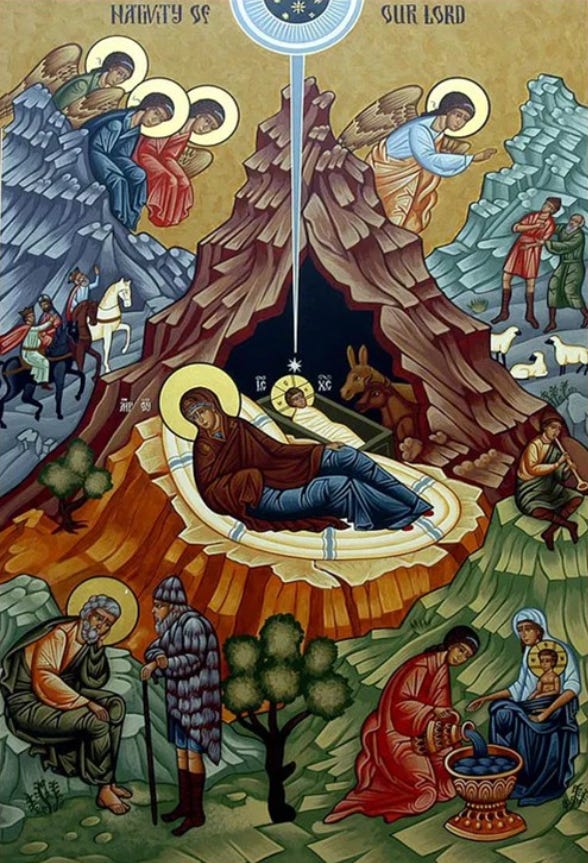
But iconography is about making a visual statement about some eternal reality, even when the image itself is a story being told. We are all familiar with the single-figure icons of course, but there are narrative icons as well. The Nativity icon is a good example of this, where a single image will have several elements of a story presented as if they’re all happening at the same visual “time”1. The format here is to have the most important thing - the Nativity itself - in the centre, with all the side adventures going on around it.
This is called “continuous narrative,” in which the same characters appear multiple times within a single image to depict successive moments in a story. Time is compressed into one pictorial space. But instead of reading left-to-right like a comic strip, the viewer follows the action throughout the composition.
This technique goes back to classical Roman art (for example, Trajan’s Column) and was taken east by Byzantine artists, where it became especially common in manuscript illumination, fresco cycles, and some icons.

Postcards are short observations centred on a single artefact or group of objects of Christian sacred art. I hope these will help readers retrain the eye and visual intellect, as we’ve discussed, to build visual familiarity slowly over time through repeated looking. We can think of them as sacred art flashcards.
New here? Start here.
The Sacred Images Project is a growing reference library dedicated to the history, theology and practice of Christian sacred art. Through essays, guided Reading Rooms, videos and other resources, we aim to recover the visual language that shaped Christian civilisation for more than a thousand years and make it accessible to artists, students and anyone who wants to understand it.
If you’ve only just discovered the project through Google, a recommendation, or a shared article, click the Start Here button below to get the big picture and find the best place to begin.
Become a member
The Sacred Images Project is becoming a permanent reference library for the history, theology and practice of sacred art.
Free subscribers receive regular public essays, news and updates.
Members receive:
Weekly subscriber-only essays and in-depth series.
Full access to the Reading Rooms as they continue to expand.
Downloadable resources, high-resolution images, shop discounts and other member extras.
Members’ discussions in the dedicated Chat, additional printable materials and videos as they are released.
Membership in the Ars Sacra Association and all future members’ benefits on the new website (in development).
Free – Public articles and updates and Notes on the Substack platform.
Annual Member – US$75/year – Full access to all member benefits.
Patron – US$125/year – For those who wish to provide additional support for the work.
If you’d prefer to set up a monthly donation in an amount of your choice, or make a one-off donation to the work, you can do that at the studio blog here:
If you set up a recurring monthly donation above $9/month, I will manually add you to the complimentary subscription list here for a year, which means you’ll have all the benefits of a paid subscription.
I hope you’ll join us.
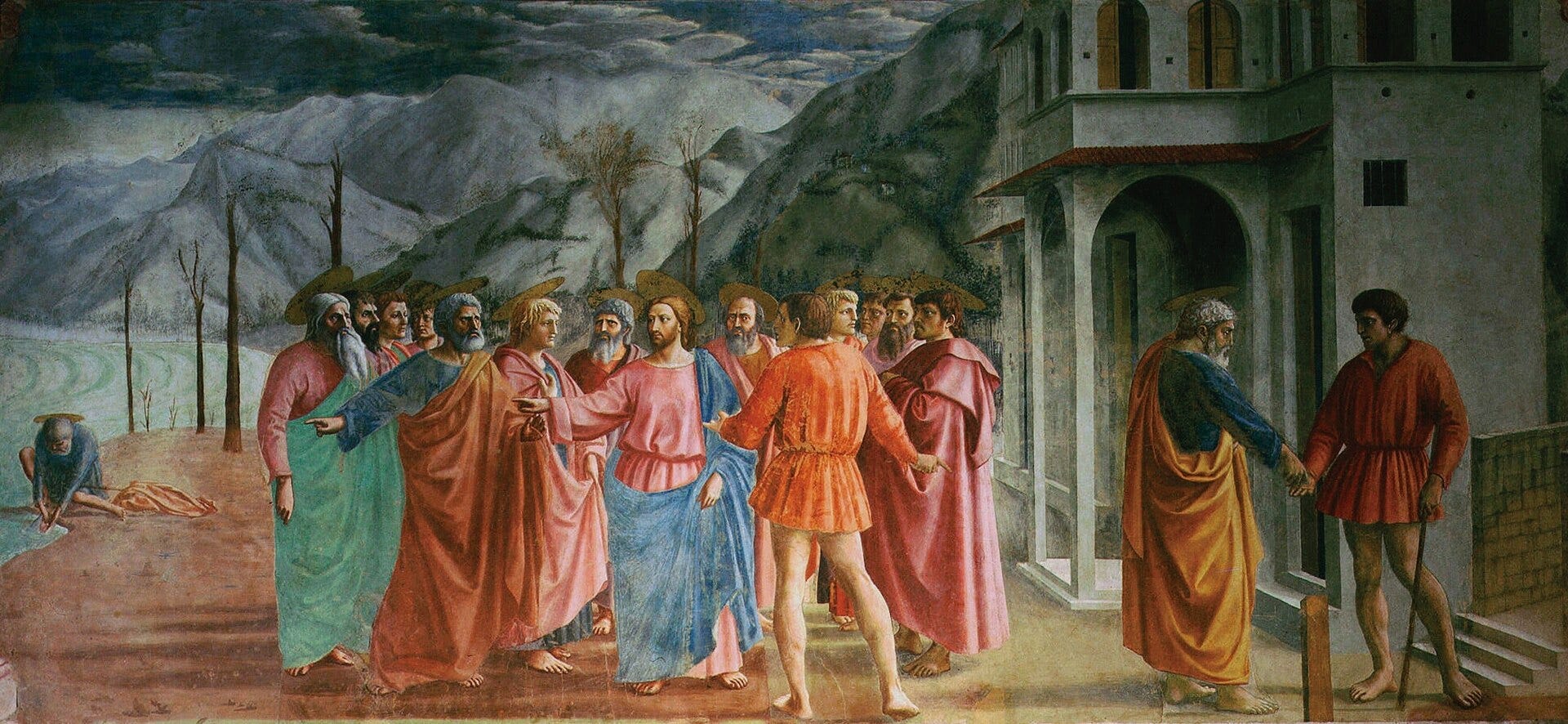
Other variants are called “synoptic narrative” – in which multiple episodes are combined into one composition - and “simultaneous narrative” – a broader term often used for images that collapse different moments in time into a single pictorial field.
There are lots of these in our collection of iconographic prototypes surviving to our time. We know what story is going on here, for example:
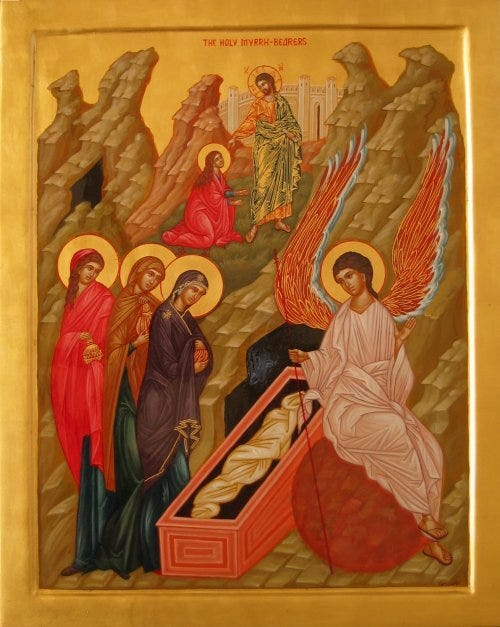
So we can contrast this “continuous narrative” type of image with what we might call “presentational” images, where it’s just one figure looking directly back at you.
Vita icons; the story of sanctification
Another way icons use narrative is to have one central figure, surrounded by a “frame” of smaller panel images, like this one of the life of St. Francis. This type, very popular in the west from the Romanesque period on, is called a Vita2, for obvious reasons.
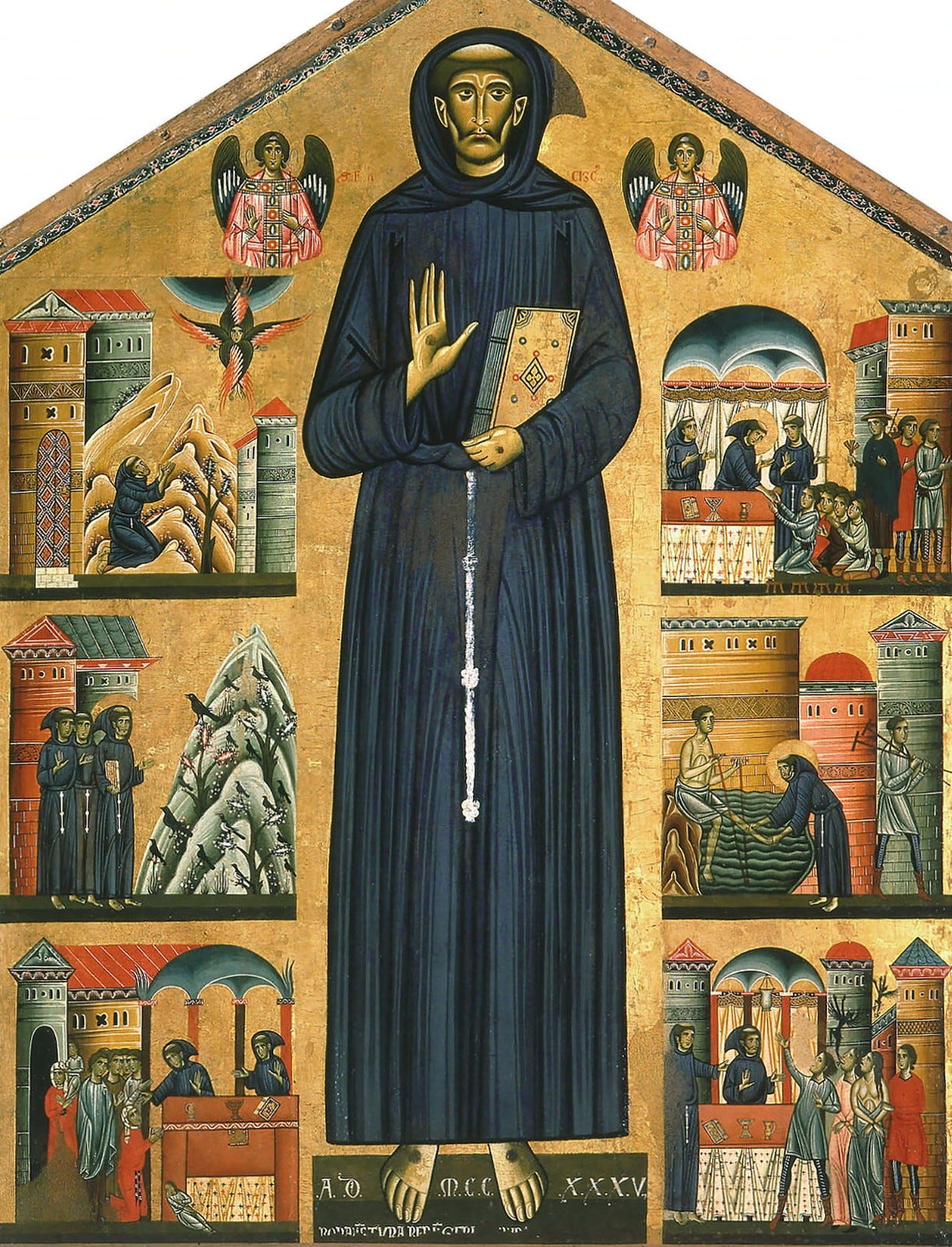
In a Vita icon, the central image shows the saint in his glorified, heavenly form, outside ordinary historical time, so is not intended as a portrait showing what the saint looked like in this world. The surrounding scenes tell the earthly story that led to that sanctification. In other words, the narrative literally surrounds the reality to which it points, and issues visual instructions on how to follow suit.
The Medieval Comic Book
In the medieval period proper, we see a development that modern audiences would recognise instantly. Instead of compressing an entire story into a single image, artists began breaking it up into a sequence of scenes. Each page, panel or relief depicts one episode, and the viewer follows the narrative by moving from one image to the next. It’s the same fundamental storytelling device used in comic books, graphic novels and storyboards today.
Of course, this kind of narrative art was very popular for manuscripts.
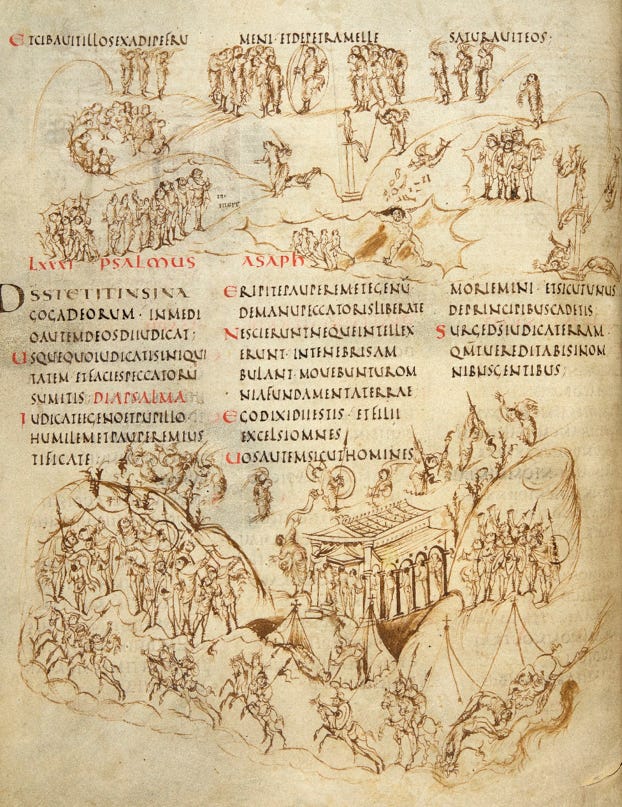
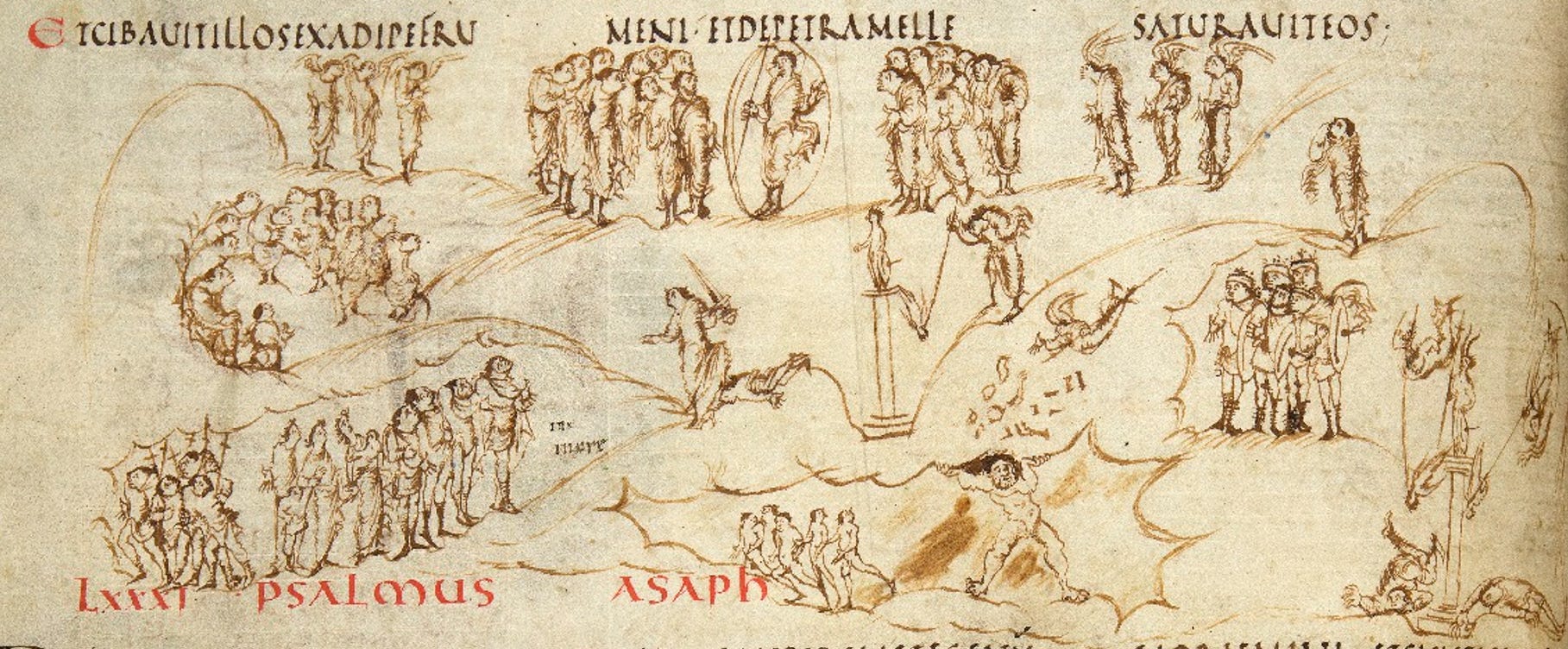
One of the great experiments in visual storytelling came as early as the ninth century with the remarkable Utrecht Psalter. Rather than illustrating just one verse from each Psalm, the anonymous artist filled every page with dozens of tiny, rapidly rendered figures in ink, illustrating the episodes of the Psalms. Figures run, gesture, fight, sing, build, flee and worship, all woven together into a single restless composition. Reading it is rather like following an animated storyboard, your eye constantly discovering the next episode hidden among the lines.
Romanesque artists embraced this idea in frescoes especially. As pilgrims walked around a cloister or a church, they were quite literally walking through the familiar stories. The narrative unfolded sequentially (though often not chronologically) in the space, and the viewer became part of the journey.
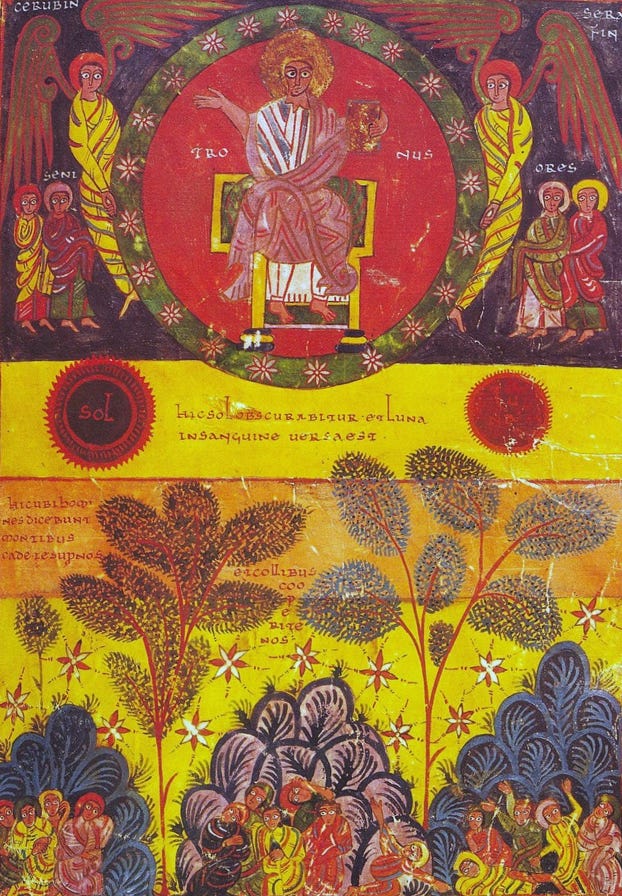
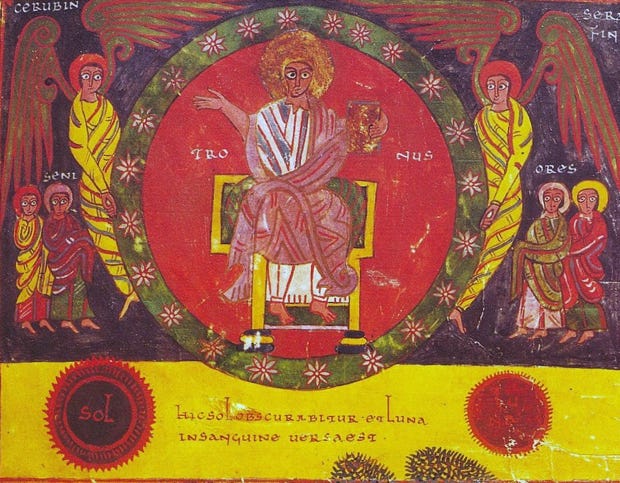
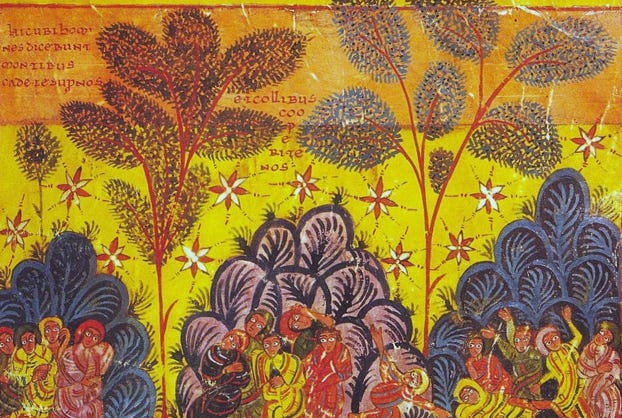
One of the most exuberant examples come from the Mozarabic Beatus manuscripts of early medieval Christian Spain. These extraordinary illustrated copies of a theological commentary on the Book of Revelation don’t attempt to present the Apocalypse as one grand symbolic vision. They unfold it scene by scene. Every image introduces a new episode: angels sounding trumpets, beasts rising from the sea, horsemen galloping across the earth, saints receiving their crowns. The colours are dazzling, the compositions audacious, and the storytelling wonderfully direct.
Medieval artists weren’t constrained by the idea that a painting had to capture a single frozen instant. They were perfectly happy to compress time, stretch it out, circle back on themselves, or tell several parts of a story all at once in a lively engaging way. Their goal was not to reconstruct an historical event as though someone had witnessed it and taken snapshots. The point was to reveal the underlying meaning.
Read more about the Beatus manuscripts here;

It’s actually a very old visual device. You see a lot of it in tomb paintings in Egypt, for instance.