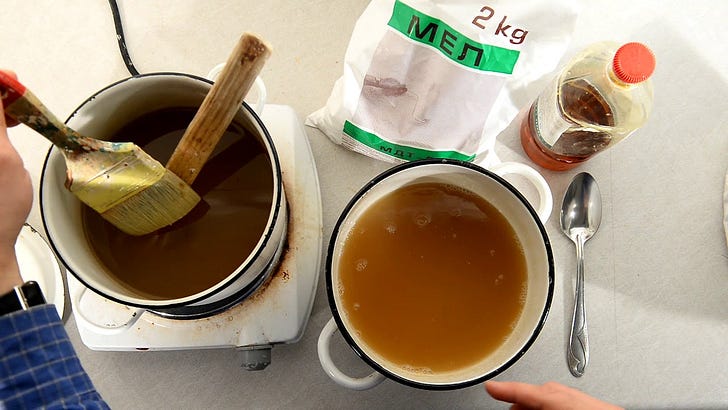
I thought it would be fun to start posting little workshop clips (very shaky, very unprofessional) showing some of the technical side of the painting process as I learn it myself.1 You can read all the books you want about all this, but there’s just no better way to learn it than by actually giving it a go.
This one is about preparing and gessoing wooden panels for egg tempera painting. For a formal icon, I buy the gessoed panel from the professional supply shop up in Veneto, but they’re very expensive and I reserve them for works I intend to sell or give as special gifts. But for more informal work, practicing and experimenting, I’ve been experimenting with gessoing my own panels. I’m also looking into fresco technique (which is quite different) and am working up the courage to give that a try.
Egg tempera cannot simply be painted onto raw wood, canvas or modern acrylic primer the way oils or acrylic paints can. Egg medium is basically a water-based emulsion of fats and proteins, so on standard modern commercial acrylic gesso it just beads up and then falls off when it’s dried. For egg tempera painting, the surface has to be rigid - so, not bendy like paper - and extremely stable and it has to be absorbent, because tempera bonds differently from oil or acrylic paints.
So, obviously traditional “true gesso,” used by Byzz iconographers and medieval painters, is not acrylic gesso at all and the ancient materials and techniques are still used by contemporary iconographers. Modern acrylic “gesso” is really just a textured plastic primer invented for contemporary paints. True gesso is an ancient mixture of animal glue and chalk or gypsum, built up in many thin layers and sanded smooth to a hard almost ivory-like texture.
This kind of panel preparation goes back centuries from the Byzantine all the way into the workshops of Cimabue, Duccio, Giotto and the early Italian painters before oil painting largely replaced tempera in the West. (You can read all about it in Cennino Cennini’s famous 15th century work, The Craftsman’s Handbook, in which he gave away all the industry’s trade secrets.)
In this instance, I’m not trying to make formal icon panels, but just to make these little wood painting panels I got on Amazon easier to do a little informal practice work on. But getting used to making the gesso, and having a grand time slopping it all over the studio and yourself, is a step on the trail.
One method for creating practice panels I’ve worked out is to buy the kind of acrylic gesso painting panels you can get easily and cheaply in any art supply shop, using rabbit skin glue to adhere high quality watercolour paper to it, and then doing a few layers of true gesso over that. It makes a really nice painting surface.
“Flooding” just means using very thinned down gesso, lots of water, and more or less pouring it on with a very wet brush. While it’s still runny-wet, you lay it flat on the table, and the surface puddles and gravity helps it settle nice and smooth
All this is slow, of course, because you have to leave the layers to dry overnight. It’s also messy, as you can see, but it is a foundational part of the craft tradition itself. One of the things that really appeals to me about this medium is actually the extra work. The craft that you have to master.
It’s also pretty fun.
Yes, I’m also working on a proper post. Don’t worry.